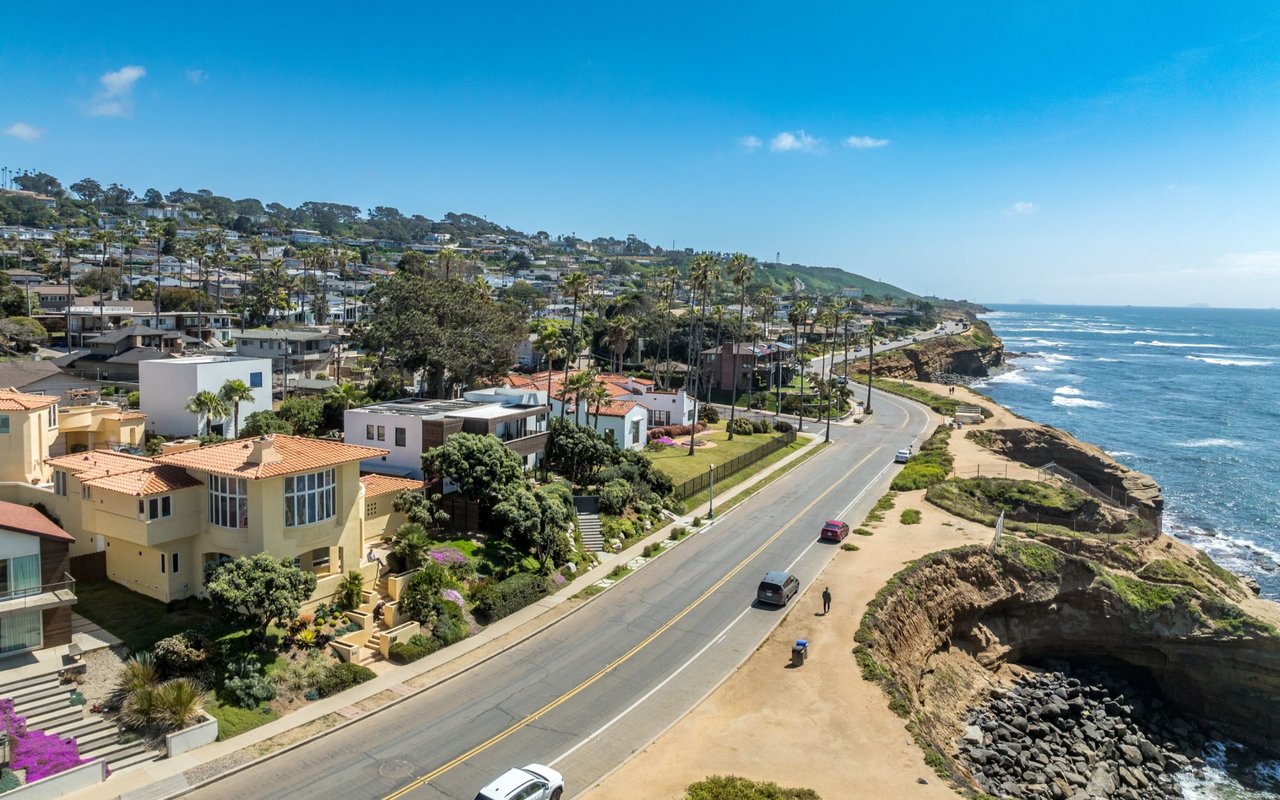
If you walked to the top of Neptune Avenue this week looking for the wooden stairs down to Grandview Beach, you found a locked gate instead. That gate wasn't there in August. The City of Encinitas had just finished celebrating the opposite news: on August 12, the City Council formally accepted the completed repair of the Grandview staircase and filed the paperwork that closes out a project years in the making. Five weeks later, on September 18, the same staircase went dark again. This time the problem wasn't the stairs.
It was the ground underneath them.
The city's notice, posted the same day, warned of a bluff failure at the site and flagged "an immediate concern of additional bluff failures" within 300 feet north and south of the staircase. Nobody touched a bolt or a beam. The structure the city just spent nearly a million dollars reinforcing is, as far as anyone has said, structurally fine. It's the hillside it sits in that moved.
A Repair Job That Actually Held Its Schedule
Give the city credit for the part it could control. The Grandview staircase, a multi-segment timber and concrete structure at the north end of Neptune Avenue, was rebuilt back in 1992 and flagged for steel and timber wear in a 2018 structural inspection. City Council approved repair plans in June 2025, awarded the construction contract that August, and crews closed the stairs on February 3, 2026. The work was substantially finished by May 22, in time for the Memorial Day weekend the city had promised. The final budget landed at $960,637.
That's a capital project doing exactly what capital projects are supposed to do: a defined scope, a contractor, a target date, and a reopening that arrived on schedule. If you'd asked the city in February when the stairs would come back, they'd have told you Memorial Day, and they were right.
Nobody could have told you September.
The Ground Doesn't Read the Punch List
A structural repair has an end point because the problem is a known set of steel connections and timber beams that can be replaced. A bluff failure doesn't work that way. The September closure statement didn't mention a reopening date, a contractor, or a budget line, because there isn't one yet. The city can bolt down a staircase. It can't bolt down a cliff.
This is also not a Grandview-specific mystery. Researchers at UC San Diego's Scripps Institution of Oceanography have monitoring equipment installed at Beacon's Beach, about a mile north, tracking bluff movement along this stretch of coastline. The instability under Neptune Avenue is part of a pattern already being studied up and down the county, not an isolated accident at one staircase. The city's own advisory for beachgoers displaced by the Grandview closure points them toward Beacons Beach and Ponto Beach as the nearest alternate access. Beacons is the same beach where scientists are already watching the cliffs for the next sign of trouble.
Every Staircase in Town Has Had Its Turn
Grandview isn't the first access point the city has had to take offline, and it won't be the last. Stonesteps went through its own structural closure in 2023 after a compromised support beam. The D Street staircase near Moonlight Beach, the most structurally complex access point in the city according to its own engineers, closed in April 2025 and reopened January 21, 2026 after roughly a million dollars of emergency bracket and timber work. City officials have said Swami's is next in line for the same kind of structural review.
Here's the pattern worth knowing if you live along this stretch of coast: every one of those projects, Stonesteps, D Street, Grandview, was a scheduled repair with a start date, a budget, and a reopening the city could name in advance and generally hit. That's the program working as designed. What happened at Grandview on September 18 sits outside that program entirely. It's not the next staircase in the queue. It's the bluff deciding the queue doesn't apply to it.
Reading a Closure Notice Like a Local
The practical difference for anyone who actually uses these stairs is this: a structural closure comes with a plan you can put on a calendar. A bluff closure doesn't, and treating the two the same is how people end up annoyed at a reopening date that was never promised. When the D Street stairs closed for emergency repairs in 2025, the city could tell residents it would take design time, permitting, and construction, and it did, reopening within the window officials had described. When Grandview closed this September, the honest answer from the city was to stay 300 feet clear and use Beacons or Ponto in the meantime. No date attached, because bluff stability studies don't run on a construction schedule.
That distinction matters for anyone weighing property near these access points too, though not in the way people assume. A staircase closure for repairs is inconvenience with an expiration date. A bluff advisory zone is a different kind of fact, one that shows up in geologic reports rather than contractor invoices, and one that's worth understanding on its own terms rather than folding into general worry about "erosion." The city has been direct about which is which. Worth reading their notices the same way.
For now, if you're used to walking down at Grandview, plan on Beacons Beach or Ponto Beach instead, and don't expect a reopening date to appear this week. The city has spent the last several years proving it can fix a staircase on schedule. It hasn't claimed it can do the same with a bluff, and to its credit, it isn't pretending otherwise.
If you're weighing a home along this stretch of the Leucadia or Encinitas coastline and want a straight read on what's a scheduled fix versus an open-ended geologic question, that's the kind of local detail Seth Chalnick tracks from the storefront in Cardiff Town Centre. Stop by or reach out before you make assumptions about what a closure sign actually means for the property next to it.